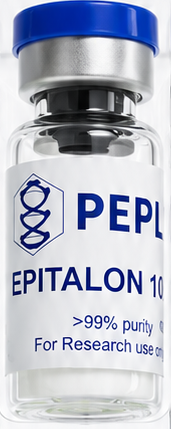
Epithalon 10mg
⚠ For in-vitro research use only. Not for human consumption. Not FDA approved.
Epithalon (also spelled Epitalon) is a synthetic tetrapeptide with the amino acid sequence Ala-Glu-Asp-Gly (AEDG). It was identified as the putative active component of epithalamin, a polypeptide complex originally extracted from bovine pineal gland tissue. The compound was first characterized at the St. Petersburg Institute of Bioregulation and Gerontology and has since become one of the most extensively studied synthetic peptides in telomere biology and cellular aging research.
Epithalon’s primary mechanism of interest involves the induction of telomerase activity in somatic cells. In telomerase-negative human fetal fibroblast cultures, the peptide has been shown to reactivate expression of the telomerase catalytic subunit (hTERT), increase enzymatic telomerase activity, and extend telomere length — sufficient to surpass the Hayflick limit, extending proliferative capacity from passage 34 to passage 44. The peptide has also been shown to enter cell nuclei and bind selectively to DNA regions rich in CAG and ATTTC repeats within telomerase gene promoter regions.
Research Applications
- Telomerase activation and hTERT expression studies in somatic cell cultures
- Telomere length dynamics and Hayflick limit extension research
- Chromatin remodeling and epigenetic regulation of aging markers
- Alternative Lengthening of Telomeres (ALT) pathway investigation in cancer cell lines
- Melatonin secretion and pineal gland function studies
- Antioxidant enzyme activity research (SOD, glutathione peroxidase, catalase)
- Chromosomal stability and antimutagenic effect studies
Published Research Context
Over two decades of published research support Epithalon’s role as a molecular tool for studying telomere biology. Khavinson, Bondarev, and Butyugov (Bulletin of Experimental Biology and Medicine, 2003) demonstrated telomerase reactivation and telomere elongation in human somatic cells. More recent work (PMC, 2025) provided quantitative data showing dose-dependent telomere extension in normal epithelial and fibroblast cells through hTERT upregulation, while cancer cell lines exhibited telomere extension through ALT activation — suggesting cell-type-dependent mechanisms. Animal studies have demonstrated increased antioxidant enzyme activities, reduced spontaneous tumor incidence, and extended lifespan in rodent models. Human clinical studies have shown significant telomere length increases in blood cells of patients aged 60–80.
Specifications
- Molecular Formula: C₁₄H₂₂N₄O₉
- Molecular Weight: 390.35 g/mol
- Sequence: AEDG (Ala-Glu-Asp-Gly)
- CAS Number: 307297-39-8
- Form: White lyophilized powder
- Storage: −20°C lyophilized; 2–8°C reconstituted
- Peplix Lot Purity: 99.775% by HPLC (Lot 2603)
- Minimum Purity: ≥98% by HPLC
- Testing Laboratory: Freedom Diagnostics
⚠ For in-vitro research use only. Not for human consumption. Not FDA approved. Certificate of Analysis included with every order.
📄 Documentation: Certificate of Analysis (Lot 2603) | Epithalon Compound Reference & Research Data | Reconstitution Calculator